
Enhance the Impact of Existing Scientific or Medical Content and Collateral With AI
A visual aid, monograph or webinar deck can support far more than its original use when the source is adapted carefully for new audiences, channels and moments.

A product monograph can take months to prepare. Medical writers review the evidence, brand teams refine the narrative and medical, legal and regulatory reviewers examine every claim. By the time the document is approved, it represents a considerable investment in science, strategy and organizational effort.
Its working life may still be surprisingly narrow.
The monograph is uploaded to a portal, printed for selected customers and used when someone needs a detailed reference. A webinar deck may disappear into an archive after the live event. A doctor newsletter is distributed once. A visual aid remains dependent on the time available during a field call.
The information continues to hold value. The original format limits when and how that value can be used.
This is where artificial intelligence offers a practical opportunity for pharmaceutical teams. Existing content can be reorganized, adapted and connected to create additional engagement experiences. The source remains recognizable, while its content begins to work across more audiences and situations.
Medical Content and Collateral: Valuable content is often trapped inside its first format
Pharmaceutical companies already own large stores of reviewed or review-ready material. These include visual aids, monographs, scientific decks, training modules, congress summaries, newsletters, patient resources, market research and brand plans.
Each asset was created for a particular purpose. Its structure reflects the audience, channel and review process for which it was commissioned.

A printed newsletter may contain material suitable for a podcast, short video or clinical quiz. A webinar may include several distinct topics that could become individual learning modules. A monograph may answer dozens of clinical questions, though a reader must search through a long document to find the relevant section.
The limitation often becomes visible only after distribution. HCPs have little time to read. Field teams need shorter and more flexible content. Medical teams receive recurring questions that the existing asset answers, but cannot always locate the answer quickly. Digital teams want material for several channels and begin commissioning new versions from the beginning.
AI can help teams examine the medical content and collateral they already have and identify useful paths for adaptation.
Begin with the source and its history
An existing asset carries more than words and images. It contains approved claims, references, review decisions, mandatory language and boundaries established during its development.
Those elements need to remain visible throughout adaptation.
The first step is to understand the source properly. Which parts are current? Which claims have been approved? Are the references still valid? What was created for internal use? What can be shared externally? Does the asset contain local language, product information or market-specific requirements?
An old asset may still have strategic value while containing information that needs updating. AI can assist with extraction, classification and comparison, but medical and regulatory judgment is required before the material becomes a source for new communication.
A useful content inventory records the origin, date, audience, approval status, references and permitted use of each component. This provides a controlled foundation for subsequent work.

Give the asset a clear new job
An adaptation works best when the communication objective is specific.
A team may want a doctor to understand a mechanism of action before a field discussion. It may want specialists and general practitioners to receive different levels of scientific detail. A training deck may need to help representatives respond to common questions. A congress presentation may need to support continued learning after the meeting.
These objectives lead to different outputs.
A short video can explain a process visually. A searchable resource can help an HCP find a specific answer. A quiz can reinforce recall. A calculator can help apply information to a defined situation. A podcast can make a discussion accessible during travel. A modular visual aid can allow the representative to select the most relevant route through a conversation.
The choice should reflect what the audience needs to understand or do next. Adding another format without a clear purpose may only increase the amount of content competing for attention.
One newsletter can become a continuing engagement program
Consider a printed doctor newsletter containing several clinical articles.
The original publication may be useful to readers who prefer a traditional format and have time to read it. Its articles can also support a wider experience.
Each article can be summarized for rapid reading. Selected topics can become short audio discussions or explanatory videos. A knowledge check can help readers revisit important points. QR links can lead to references, related resources or a subsequent edition.
Content preferences can guide the topics offered during future interactions, where consent and applicable privacy requirements allow it.
The newsletter still exists. Its content now has several routes into the HCP’s working day.
A visual aid can become more responsive to the conversation
A traditional visual aid usually presents information in a planned sequence. The representative begins at the first section and moves through the pages according to the time available.
Clinical conversations rarely follow such a tidy order.
One doctor may be interested in the patient profile. Another may want to examine the evidence. A third may raise a practical objection within the first few minutes. A linear asset can make it difficult to respond without skipping awkwardly through pages or relying on memory.
An AI-assisted version can organize approved content into modules linked to common interests and questions. The representative can reach the relevant evidence more quickly and select an appropriate follow-up resource after the discussion.
This approach requires clear rules. The system should draw from approved material, preserve required context and avoid generating unsupported responses during the call. The representative also needs to understand what the tool can retrieve and where professional judgment remains necessary.
A webinar can continue working after the audience leaves
A scientific webinar often brings together expert commentary, presentation slides, audience questions and discussion. Much of that value is concentrated within a single scheduled hour.
The recording may be available later, though few people return to watch the entire event.
AI-supported production can help divide the webinar into shorter subject-based segments, prepare a referenced summary, identify frequently discussed questions and create a sequence of follow-up materials.
The presentation can support a podcast, infographic, short video clips, a learning assessment or a concise update for HCPs who missed the event.
The expert’s meaning and the scientific context need to survive every edit. Transcripts should be checked, quotations confirmed and shortened clips reviewed for the context that surrounded them. A sentence taken from a longer clinical discussion can convey a very different impression when presented alone.

Personalisation needs a defined boundary
Pharmaceutical teams have discussed personalised content for years. AI makes it possible to produce and organize variations with much greater speed.
The useful form of personalisation usually begins with a limited set of meaningful differences. A specialist may need greater scientific depth than a general practitioner. A new representative may require more guidance than an experienced colleague. HCPs in different markets may work under different guidelines and prescribing conditions.
These differences can shape the order, depth, format and follow-up pathway of the content.
The underlying evidence and approved claims remain controlled. Personalisation determines which appropriate content is presented and how the user reaches it. It should not alter the scientific meaning to make a message appear more persuasive.
Teams need to define the variables that may change, the material that must remain fixed and the circumstances that require a new review. Without these rules, the number of possible versions can quickly exceed the organization’s ability to govern them.
Traceability has to follow every derivative
AI can create a summary in seconds. A reviewer still needs to know where each statement came from.
Traceability becomes more important as one source produces several outputs. A sentence in a podcast script may originate from a table in the monograph. A claim card may draw on a publication cited in a webinar. A quiz explanation may combine information from two approved slides.
Each derivative should remain connected to its source material. Teams can use claim identifiers, reference links, content-component records and version histories to preserve that connection.
This allows a reviewer to move from the adapted statement to the approved source and supporting evidence. It also makes future updates easier. When a reference changes or a claim expires, the team can identify the affected content across channels.
AI can assist with source mapping and consistency checks. Final responsibility remains with appropriately qualified human reviewers operating within the company’s established process.
Review models will need to accommodate modular content
Traditional review often assumes that the asset is a fixed document. A reviewer sees the full sequence and approves the final version.
Interactive and personalised experiences behave differently. The user may choose among several pathways, and individual modules may appear in more than one context.
The review process needs a clear picture of those possible experiences. Reviewers should be able to see the content components, the rules that connect them and the contexts in which each component may appear.
Some organizations may approve individual modules along with defined assembly rules. Others may review a set of permitted journeys. The right model depends on the content, risk, market and company process.
Early discussion with medical, legal and regulatory colleagues can prevent a useful concept from reaching the end of development before anyone has decided how it can be reviewed.
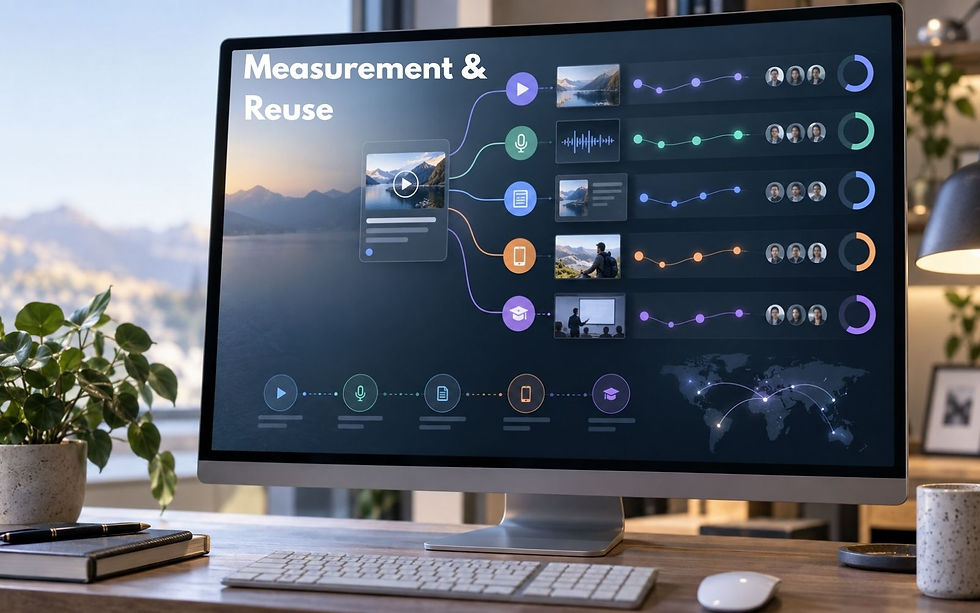
Digital adaptation can reveal how content is being used
A printed asset provides limited information after distribution. The team may know how many copies were produced, but little about which sections were useful.
Digital extensions can generate a more informative picture. The organization may be able to see which subjects attract attention, which videos are completed, where users leave an experience and which questions lead to further exploration.
These signals should be interpreted carefully. A click does not establish understanding, and time spent on a page does not establish clinical influence.
The data become more useful when they are connected to a defined communication objective. A training program can measure knowledge before and after participation. A modular HCP resource can show which clinical topics generate repeated interest. A field tool can identify where representatives need additional support.
Privacy, consent and local requirements should shape the measurement plan from the beginning.
Reuse can improve consistency as well as efficiency
Content adaptation is often discussed as a way to reduce production time. The more consequential benefit may be consistency.
When several teams commission separate assets, the same scientific idea can be described in slightly different ways. Claims may be shortened differently, references may be updated unevenly and visual explanations may drift from the agreed narrative.
A controlled source library gives each derivative a common foundation. Approved language, evidence and visual components can be reused without repeatedly reconstructing the scientific story.
This can also help global and local teams work together. A global source can provide the core narrative, while local teams adapt the channel, context and permitted content for their market. The relationship between the two remains visible.
Reuse still requires investment in taxonomy, metadata, governance and ownership. A collection of files becomes a usable content system only when people can find, understand and manage its components.
Select the first asset carefully
The first AI-supported adaptation should be valuable enough to matter and contained enough to govern.
A suitable asset usually has a strong evidence base, current approval status and an identifiable communication limitation. Teams should already know who uses it and where the present format creates friction.
A long product monograph might be useful if HCPs struggle to find relevant sections. A webinar may be suitable when there is demand for enduring education. A visual aid may offer value when field conversations vary substantially among customer groups.
The initial project can establish the working method for source preparation, adaptation, medical review, technology development and measurement. It can also show where the organization’s current systems make reuse difficult.
A small, well-controlled project often produces more useful learning than a broad transformation program with unclear ownership.
What leaders should ask before approving an adaptation
Life-sciences leaders considering an AI-enabled content project should understand the source asset, the proposed audience and the new job the content is expected to perform.
They should know which parts of the source are approved, how every derivative will remain traceable and what forms of personalisation are permitted. They should also understand how the experience will be reviewed, deployed, measured and updated.
The technology deserves attention, though it should not dominate the decision. The quality of the source, clarity of the objective and strength of the governance model will shape the value of the finished experience.
Pharmaceutical companies have already invested heavily in scientific and commercial content. Many of those assets contain more potential than their current formats allow.
AI provides a way to unlock that potential with greater speed and precision. The work begins by looking closely at what the organization already owns and deciding where it can become more useful.
Heylth’s AI-mpower service transforms existing brand, sales, medical, training, research and patient-support assets into more engaging, personalised, measurable and reusable experiences.
Discuss an existing asset and explore what it could become.


Comments